Why Shared Rooms Need More Than a Booking Calendar
Shared rooms work better when purpose, visible expectations, and a simple handover guide each visit, helping different groups use the same space with less friction.
A booking calendar can tell you who has the community room at six, but it cannot tell the next group whether the chairs should face a circle or whether the whiteboard is still needed. Shared rooms work better when clear purpose, visible expectations, and a simple handover travel with the reservation. These small agreements help a room serve different users without adding equipment or turning every visit into a negotiation.
Give the room a purpose
A room meant for everything often feels ready for nothing. One group arrives expecting a quiet place to talk; another expects space to spread out craft supplies. The calendar records the time, but the room’s purpose sets a useful starting point for deciding what belongs there and what “ready” means.
A purpose does not have to exclude activities. It can describe the room’s basic promise: a place for small meetings, neighborhood classes, or quiet drop-in use. A library meeting room, for instance, might support both a tenant discussion and a language lesson while keeping the same core expectations: leave a clear route to the door, return shared tables to their usual arrangement, and keep conversations at a level suited to the building.
That description gives users a way to judge whether their plans fit. If a group needs a different setup, it can ask in advance rather than assuming the room will adapt. The person who manages bookings can also identify incompatible requests early, before one reservation affects another.
Make expectations visible
Rules hidden in an old email are easy to miss, especially for someone using the room for the first time. Put the essential expectations where they can be seen before or during the visit: in the booking confirmation, on the door, or in a short note beside the calendar. Keep the wording specific enough to guide action.
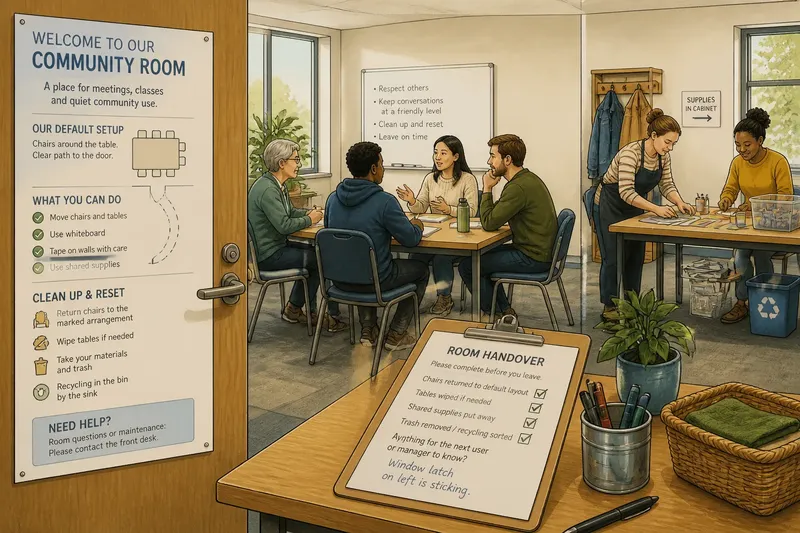
“Leave the room tidy” sounds clear until users disagree about what tidy means. A more useful note might say to put chairs back in the marked arrangement, wipe the table if it has crumbs or spills, and take personal materials away. If the room has no marked layout, name a simple default such as chairs around the table.
Expectations should also say what users may do, not only what they must avoid. Can a group move chairs? Is tape allowed on the walls? Where should recycling go? Naming the permitted options helps people make ordinary decisions without seeking approval for every small adjustment.
Keep the rules short enough to scan. A notice crowded with every unlikely exception can bury the few instructions that prevent confusion. Separate routine use from special requests: state the ordinary arrangement plainly, then give a contact route for needs that fall outside it.
Use a simple handover
The handover is the small bridge between one booking and the next. It is not a formal inspection. It is a brief exchange of useful information and a return to the room’s agreed starting condition. A consistent handover prevents users from inheriting surprises and makes it easier to spot a problem before it becomes someone else’s problem.
For a room with back-to-back bookings, the handover can be a short checklist attached to the booking confirmation. Ask each group to note whether the usual arrangement is restored, whether shared supplies have been put away, and whether anything needs attention. For a room used less often, a quick look at the space before locking up may be enough.
Say a neighborhood language group finishes a lesson and notices that the next booking is a quiet counseling session. The group returns the chairs to the posted layout, clears its handouts, and leaves a note that a window latch is sticking. The next user enters a predictable space and the room manager has a specific maintenance issue to follow up, rather than a vague report that something was wrong.
Keep the handover focused on what the next user needs. It is not a place to review the previous group’s choices or ask users to document every detail. A brief, neutral record makes the room easier to share without making access feel like paperwork.
What should users know?
What belongs in a room-use note?
Include the room’s usual purpose, the default furniture arrangement, basic cleanup expectations, and a contact for access or maintenance questions. Add only the rules that apply to this particular room, such as where to leave a key or how to handle shared supplies.
How can groups request a different setup?
Give users a simple way to mention changes when they book, such as a reply to the confirmation or a note in the reservation form. Explain which changes they can make themselves and which need advance approval so the next booking is not disrupted.
What if a group finds the room already out of order?
Ask users to report the condition briefly before resetting anything that could belong to the next group. A message such as “chairs were in rows on arrival” gives the room manager useful context without assigning blame or starting a dispute.
Who should update the expectations?
The person or organization responsible for the room should review the note when recurring questions or handover problems point to a gap. Users can suggest changes, but one designated contact should keep the posted version consistent with the booking information.
Design for different users
A shared room can welcome different activities without pretending every activity has the same needs. The useful distinction is between a stable baseline and a temporary setup. The baseline keeps access, cleanup, and the room’s basic purpose consistent; the temporary setup lets a group arrange the space for its own work and restore it afterward.
That balance also helps people who are less familiar with the building. A first-time user should not have to guess whether a stack of folding chairs is available or whether a locked cabinet is off limits. Plain labels and a clear contact person can answer those questions without buying additional equipment.
Pay attention to the words as well as the furniture. “For community meetings” may sound welcoming but leave a class, support group, or informal gathering unsure whether it qualifies. Describe the room in terms of the activities it can accommodate, and invite users to ask when their plans do not fit the description.
Keep the agreement alive
Expectations should change when the room’s use changes. If several groups repeatedly ask where to put materials, the answer may belong in the room note. If users keep restoring chairs to different arrangements, the stated default may not match how the space actually works. Treat recurring confusion as a cue to clarify the agreement, not as evidence that users are careless.
Make changes through the same channels people already use. Update the posted note and the booking message together, and mention the change to regular groups. A rule that appears in only one place creates two versions of the room’s instructions.
Shared rooms need more than a booking calendar because a reservation marks time, not readiness. A clear purpose, visible expectations, and a modest handover give each user a fair starting point and a practical way to leave the room for the next person. When those three parts are easy to understand, the room can support different groups without requiring extra equipment or constant supervision.
For anyone responsible for a shared room, the most useful improvement may be a short, readable description of what the space is for and how each visit should end. Put it where users make decisions, then adjust it when real questions reveal what is missing. That keeps the room’s agreement as available as the room itself.