The Lost-Item Box Is Not a Storage Plan
A lost-item box sorting routine helps householders reunite owners with found belongings, clear out unclaimed clutter, and keep only what has a useful next step.
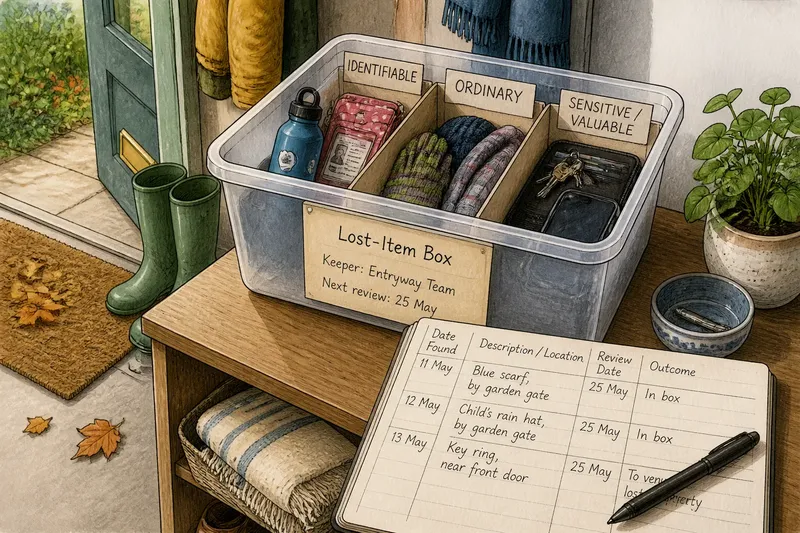
A lost-item box sorting routine keeps found belongings visible long enough to be claimed without turning a helpful gesture into permanent household storage. A damp mitten, a key ring, and a water bottle can all begin with the same good intention: put them somewhere safe. The trouble starts when nobody knows what is there, how long it has been waiting, or who should decide its next destination.
Set up a short, repeatable routine instead. It should make found things easy to identify, protect private details, and give every item a clear end point. This is for the ordinary collection near a front door, in a shared household, or at a small neighborhood gathering place—not a substitute for an organization’s formal lost-property rules.
Choose one responsible keeper
Before sorting, decide who owns the task. In a household, that might be the person who handles the entryway. In a club or community room, it should be someone with permission to manage the box. A shared pile with no named keeper usually becomes nobody’s responsibility.
Keep the box in a dry, visible place that is not a public invitation to rummage through private contents. A lidded plastic bin or a sturdy cardboard box on a shelf can work. Add a card with the keeper’s name or contact route and the date of the next review. Treat the box like a kitchen counter: useful when it has a purpose, frustrating when it becomes a surface for everything.
Use a notebook or a simple paper log, not a complicated tracking system. Record the date found, a neutral description, and the date to review it. Avoid writing sensitive details where passersby can read them. For a private household, a note such as “blue scarf, by the garden gate” is often enough. For a community venue, follow its established process and keep access limited to the people assigned to lost property.
Sort before storing
Handle each new object once, then put it into one of three practical groups: identifiable, ordinary, or sensitive. These categories help you choose a response without treating every object as equally easy to return.
- Identifiable: Items with a name, contact detail, distinctive tag, or clear connection to a person or place. Keep identifying details private and use a suitable contact route to reach the likely owner.
- Ordinary: A plain glove, reusable cup, or unmarked scarf. Record a concise description and the location where it turned up. Keep it together with similar items.
- Sensitive or valuable: Keys, wallets, devices, cards, medication, or anything that could expose personal information or create a safety concern. Do not leave these in an open household box; take them to the appropriate responsible person or service.
Do not post a photograph that exposes a name, address, card number, screen, or distinctive key. If you use a neighborhood message board to locate an owner, describe only enough to prompt a private claim. Ask the claimant to identify a feature you have not shared publicly. For an item that could affect someone’s safety or privacy, a relevant professional or organization is the better contact than a public post.
Set the review date
Choose a review date when the item enters the box, rather than waiting until the box is full. The appropriate holding period depends on where the object was found, how likely its owner is to return, and any rules set by a venue or local authority. Check those rules once before choosing a household routine; where a label, manufacturer’s instructions, or local requirements govern an item, follow them.
For a household collection, a weekly glance and a more deliberate review on a regular calendar day can keep the task small. Put the review date on the box card or household calendar. If the keeper will be away, name a backup rather than letting the review quietly disappear.
At review time, check the log against the contents. Remove anything already reunited with its owner, and note the outcome. Then ask of each remaining item: Is there a credible route back to its owner? Is it safe and appropriate to keep? Does the keeper have authority to decide what happens next? If any answer is no, pause and refer the item to the responsible venue or service rather than improvising.
Move each item onward
Every item left after review needs a defined outcome. Depending on the item and the setting, that may mean another reasonable holding period, transfer to a venue’s lost-property contact, or disposal through an appropriate channel. Do not assume that donation or reuse is suitable: a found object may still belong to someone, and some items are not suitable to pass on.
Imagine a household finds a plain child’s rain hat beside its shared garden gate. The keeper notes where and when it appeared, places it in the ordinary-items section, and adds a review date. At the next review, no one has claimed it and there is no venue policy that applies; the keeper can then make a sensible decision about an additional brief hold or an appropriate reuse route, and record that the item has left the box. The observable result is a dated record and an empty place for the next find—not an object left indefinitely because nobody wanted to make the call.
For a public building, school, transit stop, or organized event, hand the object to the designated lost-property contact. Do not quietly remove an item from a place where staff or local rules require it to remain. When a claim is made, confirm the claimant can identify the item, arrange a safe handoff, and mark the record closed. Avoid collecting more personal information than the handoff requires.
What should happen next?
How long should a found item stay in the box?
Use a review date suited to the place, the item, and the applicable policy; there is no single holding period that fits every setting. Record that date when the item arrives, then follow the venue’s process if one applies.
Should found items be posted online?
A brief description can help an owner recognize an ordinary object, but leave names, addresses, account details, and identifying photographs private. Invite claims through a private channel and ask the claimant to describe a feature not included in the post.
What should I do with keys, wallets, or phones?
Keep them out of an open household collection and transfer them to the appropriate responsible venue or service. These objects can expose private information or create security concerns, so a public notice with identifying details is not a suitable shortcut.
Can unclaimed belongings be donated?
Only if you have authority to decide and the item is safe and suitable for reuse. If ownership, venue rules, or local requirements are unclear, ask the responsible organization before transferring or discarding it.
Keep the routine small
A usable lost-item box sorting routine depends on a few visible habits: one keeper, a discreet log, a review date, and an outcome for every item. Keep the box limited to found belongings, not things someone means to return someday or objects awaiting a separate household decision. If it is full, pause new intake until the review is done.
Tell household members or venue staff where found objects go and whom to contact for a claim. That small bit of shared knowledge prevents duplicate boxes and makes it less likely that an item will be taken home by someone who was only trying to help. Most of all, treat keeping as a temporary service with a decision attached—not as proof of care. A clear handoff, a discreet return, or a considered end to the holding period is what lets the box stay useful.